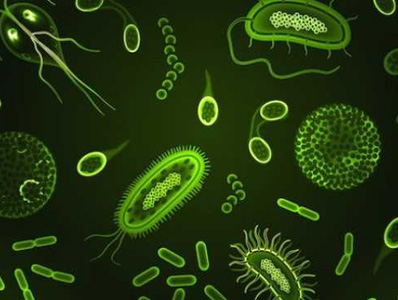
Microbes sustain life on earth and they have relationships we are just beginning to understand leading us to discover these smallest of small critters and animals are the basis of all life.
The floriculture of microbes is called the soil microbiome and it is very similar to our humanbiome and definitely intricately connected. Unseen (with our eyes) microbes have a collective mass greater than all the animals on the planet. In the human, there are more microbes then human cells.
We are here because of the microbes and we live in their world!
Microbes (also called microorganisms) are literally everywhere. They grow and reproduce in and on your body, and on rocks, within plant roots and on their leaves, in wetlands, oceans and fresh waterways. And, microbes are in soil. There are more microbes in a teaspoon of soil than there are people on the earth. There are more microbes in your gut than human cells in your body. Soils contain about 8 to 15 tons of bacteria, fungi, protozoa, nematodes, earthworms, and arthropods.
Therein likes the difference to soil and dirt. There is a big difference. The Father of Soil Science, Hans Jenny, defined the 3 components of soil. The first is mineral (texture) which is the sand, silt and clay. Organisms are the second component. And, the third is the organic matter (OM). Without the microbes or the OM, it is simply dirt and void of life.
In the soil, the microbes decompose and recycle; keep us healthy, make the oxygen we breathe, fix nitrogen, control pollution, are a source of renewable fuel. They literally feed the world! Without them, there is no food! And, without these microbes healthy we may have a plant we can eat force with “ides” and “izers” but it contains no nutrients. It is like the difference between a tablet of processes vitamin C and a sprig of parsley from good soils.
It is a web of precious live science has neglected for too long Soil microbes throught recycling and decompossition release chemicals (such as carbon, nitrogen, and phosphorus) that can be used to build new healthy plants (and animals). So, the flower or a vegetable will eventually become part of another living thing chemically. So the next time you see cut flowers decay or a garden vegetable rot, remember, you’re really seeing microbes at work.
Our understandings about these microbes is now giving us solid information about how to provide the environment and the biology to ensure the good microbes thrive. Science is now discovering the microbe world in research that “…just like the human gut or plant roots, the hyphae of AM fungi have their own unique microbiomes,” Scientist at the Maria Harrison, Scientist at the Boyce Thompson Institute (BTI) “https://www.eurekalert.org/pub_releases/2021-04/bti-fcm040221.php?fbclid=IwAR28ooKSVt8nVrEltXp0d0vz2Z6XSv-SpaBb2Bw7RaiMezc1UUBg1yMkDQM
Everything has a symbiotic relationship. For example, all living things require nitrogen for building DNA, RNA, and protein molecules. We knew nitrogen is abundant in the atmosphere but only a few species of microbes can use it in this form. All other organisms depend on certain bacteria that produces enzymes that convert or “fix” gaseous nitrogen (N2) into a form other organisms can use (such as ammonium (NH4+) or nitrate (NO3-)). Nitrogen-fixing bacteria depend on plants for food therefore forming a symbiotic (or mutually beneficial) relationship. Animals (including us humans) in turn acquire nitrogen by eating plants and plant-eaters.
Other metabolically talented microbes can metabolize metals, acids, salt, methane, or even radioactive wastes. We are discovering a microbe for every pollutant. Thus microbes can treat sewage, clean abandoned mines, and degrade a variety of industrial chemicals.
We are just beginning to understand and appreciate this minute world at greater depths. Maybe it is just in time because we have spent years destroying them and following practices (both chemical and organic) that have harmed their cycle of life. Soil biology is the mediator of life on Earth. It is the function of the biological systems acting as the “gut” of plants.
When we look into the soil with our microscopes we want to see bacteria, fungi, yeasts, protozoa and nematodes. They act as microbes in the gut biome to solubilize, sequester and digest the minerals from the sand, silt, clay, rocks, pebbles and crop residues into plant available nutrition. This nutrition translates for us humans as amazing “taste” that is satisfying. This is referred to as nutrient cycling and in symbiosis with plants, they (the microbes) are critical for carbon cycling also.
We all, farmers and gardeners alike, are realizing this the soil biological system that literally is the “gut” of our environment. Big money AG and the wrath of herbicides, insecticides, fungicides, soluble fertilizers and tillage have left soils void of some of these microscopic soil managers. They are out of balance. Without them, we are left to chemistry that may superficially be a short fix but it is harming the critters. As our understanding of many of the “-cides” used in agriculture increased, it is clear how devastating these can be to the microbes. We need to eliminate or at the very least, use wisely, all forms of insecticides and fungicides so as to not compromise the biodiversity. We need to rebuild the biodiversity.
One of the fundamental theories from soil consultants is that not all soil testing is created equal. Simplistic N-P-K and pH tests are fine for determining fertility needs, but worthless when it comes to rebuilding soils. To rebuild you have to understand the microbiology.
It is important that we remember to view soil as a habitat and an ecosystem, and to shift our mindset from feeding plants to feeding the soil, which will in turn feed the plants and support them in many other ways. Microorganisms are “everything” and is relevant to everybody. The proof is around us everywhere. Microbes actually do everything.
Soil microbes are the simpliest of creatures that created our environment we live in. In our soil microscope and compost making we are particularly interested in bacteria, fungi, protozoa, nematodes and soil microaggregates (held together by the microorganism glue).
There are microbes in us, on us and acting upon everything around us. If we don’t understand them and stop harming them, there will be no nutrition from our plants and we will left with only “dirt”, barren land, anaerobic conditions and life will cease. We have to look at this differently. We have help the microbes thrive. We all need to eat and we all need healthy nutrition. Microbes are responsible for creating soils we all desperately need.
Recently, so many insights into how life happens becauses of microbiology. The microbes are the engines of production and understanding their role and helping them flourish translates to true sustainability longterm. As we learn more and more we realize they offer roots to all the solutions we are seeking…at least the most fundamental issue we are face with collectively and that is “health”. It is important now and even more important in the future. Taking care of the soil is taking care of the whole!