Description
Parsley Root Dried
Petroselinum crispum
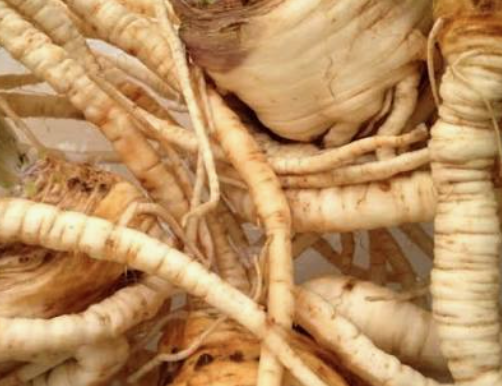
Parsley root is one of those herbs that almost disappears in plain sight. We know parsley as the bright green sprig on a plate or the handful of leaves chopped into food, yet underneath the soil is a completely different part of the plant, dense, aromatic, earthy and traditionally valued as both food and medicine.
The root has a warm, slightly sweet, distinctly parsley-like flavor with an earthy depth that develops beautifully when simmered. It can be made into tea or decoction, added to broths and soups, incorporated into herbal formulas or combined with other roots and herbs.
Parsley root belongs to the Apiaceae family, alongside carrots, celery, fennel and parsnips. The family relationship becomes much easier to recognize when you smell or taste the root. There is that familiar aromatic quality, but parsley root has its own character: less sweet than carrot, more earthy than the leaf and surprisingly substantial for a plant that many people know only as a garnish.
The Root Beneath the Parsley
A root is not merely an anchor holding a plant in the ground. It is one of the busiest places in the entire plant.
Parsley sends carbon made through photosynthesis downward into its root system. Around those roots lives the rhizosphere, the extraordinarily active zone where plant roots, minerals, organic matter, moisture and microorganisms meet. Root exudates feed microbial communities, microbes participate in nutrient cycling, and the plant selects and exchanges within that underground community.
What we eventually harvest as parsley root has therefore been formed through an ongoing relationship between sunlight above the soil and biology beneath it.
The root stores compounds the plant needs for growth and survival. When it is harvested and dried, its water is removed, concentrating its characteristic aroma and flavor into a root that can be stored and used throughout the year.
This is part of what makes roots so interesting in herbal medicine. We are working with the underground storage organ of the plant, the part physically embedded in the soil food web throughout its life.
Parsley Root and the Urinary System
Parsley has a very long traditional relationship with the kidneys, bladder and urinary system. Parsley root in particular has historically been included in herbal preparations intended to encourage normal urinary flow.
Herbalists sometimes describe plants with this action as aquaretic or diuretic herbs. In practical terms, the traditional purpose is to encourage the movement of water through the kidneys and urinary tract.
There is an important distinction here. The goal is not simply to make the body “lose water.” Water movement is part of a much larger physiological process involving minerals, blood volume, kidney filtration, hormones and electrolyte balance.
Our kidneys continuously filter the blood, returning what the body wishes to keep while moving metabolic waste and excess compounds toward the urine. They are constantly making decisions about sodium, potassium, water and acid-base balance.
Parsley root became a traditional herbal companion to this process.
Modern research on parsley is beginning to investigate its effects on urinary composition and kidney physiology. There are interesting findings, but human research remains limited, so parsley root is best described according to its long traditional use rather than presented as a treatment for kidney disease.
Food, Water and Minerals
Parsley root also reminds us that hydration is much more interesting than simply drinking water.
Water must move into and out of cells, and that movement is intimately connected with minerals and electrolytes. Sodium, potassium, magnesium, calcium and other minerals participate in the electrical and osmotic relationships that allow water to move through tissues.
Plants obtain their minerals from the soil system. They do not manufacture minerals. Minerals come from rock, organic matter and the cycling activity occurring within living soil.
Microorganisms help transform nutrients into forms plants can access. Plant roots then take those minerals into living tissue, where they become incorporated into the chemistry of the plant.
When we eat or prepare those plants, another stage of the cycle begins.
Soil becomes plant.
Plant becomes food.
Food meets the human digestive system and the microbiome.
Nutrients are transformed again and eventually return through our own biological cycle.
Parsley root is a particularly lovely herb through which to see that entire journey because we are literally consuming the portion of the plant that lived within the soil.
Parsley Root and Digestion
Parsley also has a traditional reputation as a digestive herb.
Its aromatic compounds provide the characteristic scent that is released when parsley root is simmered, crushed or soaked. Aroma is chemistry. Those volatile compounds are part of the plant’s communication and defense system and part of what our own sensory system recognizes as flavor.
Aromatic plants have been used around meals across cultures for a very long time. Parsley, celery, fennel, coriander, dill and many other members of the Apiaceae family found their way into kitchens partly because they taste good and partly because traditional food cultures recognized that aromatic plants worked beautifully with digestion.
Parsley root can therefore be used in a way that blurs the distinction between culinary and medicinal preparation.
A little dried parsley root added to a soup is food.
A larger amount gently simmered in water becomes an herbal decoction.
Combined with other roots and herbs, it becomes part of a formula.
There does not always have to be a hard line separating the kitchen from the apothecary.
The Bitter-Aromatic Digestive Conversation
Parsley root is not intensely bitter, but it carries a mildly bitter, aromatic and earthy quality.
Taste itself begins digestion. The moment aromatic and bitter compounds contact receptors in the mouth, information begins moving through the nervous and digestive systems. Salivation changes, digestive secretions respond, appetite can shift and the body begins preparing for what is coming.
Then the plant reaches the intestinal ecosystem.
Here another transformation begins. Plant fibers and phytochemicals encounter digestive enzymes and the enormous community of organisms that make up the intestinal microbiome. Human enzymes transform some compounds directly, while microbes participate in transforming others into metabolites with different biological properties.
This is one reason whole plants are so fascinating. The chemistry we swallow is not necessarily the chemistry that ultimately circulates through the body. Digestion and microbial metabolism continue the plant’s transformation.
The medicine is not simply sitting inside the parsley root waiting to be released. It emerges from relationship.
What Is Inside Parsley Root?
Parsley contains a remarkably complex collection of plant compounds.
Researchers have identified flavonoids and other phenolic compounds as well as aromatic volatile constituents. Parsley species contain compounds such as apigenin-related flavonoids, apiin, myristicin and apiol, though the proportions vary between the leaves, roots, fruits and different varieties of parsley.
The root has its own chemical profile. Parsley root volatile oil, for example, differs from parsley leaf oil and parsley seed oil.
That difference matters because herbalism works with plant parts, not simply plant names.
A parsley seed is not chemically identical to a parsley leaf.
A leaf is not identical to a root.
A concentrated essential oil is not equivalent to a cup of root tea.
Each preparation carries a different concentration and balance of compounds.
This is also why traditional preparation methods matter.
Parsley Root as a Decoction
Because parsley root is tougher and denser than a leaf or flower, it is generally better suited to a decoction than a quick infusion.
Place approximately 1 to 2 teaspoons of dried parsley root into a cup to a cup and a half of water. Bring the water gently toward a simmer, cover and allow the root to simmer very gently for approximately 10 to 15 minutes.
Turn off the heat and allow it to sit for another few minutes before straining.
The resulting drink is earthy, aromatic and pleasantly root-like. It can be taken alone or blended with other appropriate herbs.
Roots generally benefit from this longer water extraction because their cellular structure is tougher than delicate leaves and flowers. Heat and time allow water to penetrate the dried root and draw soluble compounds into the liquid.
Parsley Root in Broth
One of my favorite ways to think about parsley root is not as a “tea herb” at all, but as a broth herb.
Add dried parsley root to a long-simmered vegetable, mushroom, chicken or bone broth. The flavor integrates beautifully with onion, celery, carrot, garlic and garden herbs and brings another layer of earthy depth.
This approach brings herbal medicine right back into the kitchen.
The broth extracts water-soluble plant compounds while also carrying minerals, amino acids and compounds released from the other ingredients. The result is not one isolated herb performing one isolated action. It becomes a whole-food preparation containing many forms of plant and food chemistry.
That is much closer to the way humans have traditionally interacted with medicinal plants.
Parsley Root and the Liver
Parsley also has a long history as a traditional “tonic” herb associated with digestion and liver function.
The liver sits at the center of an enormous amount of metabolic chemistry. Nutrients arriving from the digestive system travel to the liver, where they are transformed, stored, packaged, released or further metabolized according to what the body requires.
The liver and kidneys also work closely together. The liver transforms many compounds into forms that can eventually be moved out of circulation, while the kidneys participate in filtering and excreting water-soluble metabolic products.
Parsley root’s historical association with both digestion and urinary flow therefore makes sense when we look at the body as an interconnected metabolic landscape.
The organs are not independent departments. They communicate continuously.
The Microbiome Connection
Parsley root also brings us into the microbiome.
Whole roots contain plant fibers and phytochemicals, and these compounds become part of the material entering the intestinal ecosystem. Some are digested and absorbed by us, while others encounter microbial enzymes.
Microbes are remarkable chemists.
They can split, transform and remodel plant compounds that our own digestive enzymes cannot process in exactly the same way. This means the biological story of a plant continues after we eat or drink it.
The soil microbiome participates in creating the plant.
The intestinal microbiome participates in transforming the plant.
The human becomes the meeting place between two microbial worlds.
This relationship is especially easy to imagine with a root. One microbial ecosystem surrounds that root while it grows. Another microbial ecosystem encounters it after we consume it.
The same plant connects both worlds.
Parsley Root in Herbal Blends
Parsley root combines well with many food-like and traditional herbal ingredients.
It can be paired with nettle, dandelion root, celery seed, coriander, fennel, ginger or other roots and herbs depending upon the purpose of the preparation. For a nourishing broth, it works beautifully with carrot, celery, onion, mushrooms and garden herbs.
It can also be used simply by itself.
An herb does not always need a complicated formula surrounding it. Drinking a simple parsley root decoction allows you to become familiar with the plant’s taste, aroma and character before combining it with anything else.
The Kitchen Apothecary
Parsley root represents something important about traditional plant medicine: many useful herbs never belonged exclusively in a medicine cabinet.
They belonged in soup pots.
They grew beside the kitchen.
They were dug from gardens.
They were dried after harvest.
They were added to food when fresh plants were unavailable.
They became broth, tea and seasoning depending upon what the household needed.
Modern culture has created a strong division between food and medicine, but plants did not evolve according to those categories.
Parsley root fits beautifully into the space between them.
From Living Soil to Living Body
A parsley seed begins with almost nothing visible.
It germinates, sends a root downward and a shoot upward. Sunlight supplies energy. Leaves begin capturing carbon dioxide from the atmosphere. Roots release compounds into the soil around them. Microbes gather around those roots. Minerals cycle. Water moves. Carbon travels downward from the leaves into the soil ecosystem.
Gradually, the root thickens.
Months later, we harvest it.
Once dried, that root can sit quietly on a shelf for many months, appearing almost inactive. Add water and heat and another transformation begins.
The aromatic compounds emerge into the steam. Soluble plant constituents move into the water. We drink the decoction, and the chemistry enters an entirely new ecosystem inside the body.
That is the larger story contained in something as simple as dried parsley root.
How to Use Dried Parsley Root
Dried parsley root can be used for herbal decoctions, broth, soups, culinary preparations, tinctures and herbal formulas.
For a simple decoction, gently simmer approximately 1 to 2 teaspoons of dried root per cup of water for 10 to 15 minutes. Strain and enjoy warm.
For broth, add the root directly to the pot along with vegetables, bones, mushrooms or other herbs and strain at the end of cooking.
Because dried roots absorb water and soften during cooking, parsley root can also remain in rustic soups where the cut of the herb is appropriate.
Taste: Earthy, aromatic, mildly sweet and slightly bitter.
Plant part: Root.
Botanical name: Petroselinum crispum.
Family: Apiaceae.
Preparation: Decoction, broth, soup, tincture or herbal blend.
Storage: Keep tightly sealed in a cool, dry location protected from direct sunlight and moisture.
Important Safety Information
Parsley used in ordinary culinary quantities is a familiar food. Concentrated medicinal use is different, particularly when using the root, seed, extracts or essential oil.
Medicinal amounts of parsley root are generally avoided during pregnancy because parsley has a historical association with stimulating menstrual and uterine activity. Culinary amounts of parsley as food are a different level of exposure from concentrated herbal preparations.
People with diagnosed kidney disease, significant fluid-balance disorders, or those taking prescription diuretics or medications where fluid and electrolyte balance is important should discuss regular medicinal use with an appropriately qualified practitioner.
Large medicinal quantities should not be confused with normal use of parsley as food. Concentrated essential oil preparations are also completely different from dried parsley root and should not be dosed as though the two preparations were interchangeable.
A Root That Deserves More Attention
Parsley root is easy to underestimate because parsley itself is so familiar.
Yet beneath that familiar green plant is a root connected to an ancient herbal tradition involving digestion, urinary flow, food preparation and the movement of water through the body.
There is an even larger story beneath it.
The plant grew through relationship with soil organisms. Its roots participated in a living underground economy of carbon and minerals. We harvest that root, bring it into the kitchen, add water and heat, and then introduce its plant chemistry into another living ecosystem inside ourselves.
From soil microbes to root.
From root to kitchen.
From kitchen to intestinal microbes.
From microbes to human metabolism.
Parsley root may look like a simple dried herb in a jar, but there is an entire living cycle contained within it.
Ingredients: 100% dried parsley root, Petroselinum crispum.